
The Brahma Temple in Pushkar, Rajasthan, is one of the most revered temples dedicated to Lord Brahma, the creator of the universe in Hindu mythology. Situated near the sacred Pushkar Lake, the temple holds immense religious significance for Hindus. It is believed to be one of the very few temples dedicated to Lord Brahma in the world, making it an important pilgrimage site.
The temple and lake are closely connected, and their combined spiritual importance has led Pushkar to be known as Gurutirth, meaning the senior-most pilgrimage site. Just as Prayag is called Tirthraj, Pushkar is honored as Pushkar Raj in Hindu tradition.
Main Deity: Lord Brahma
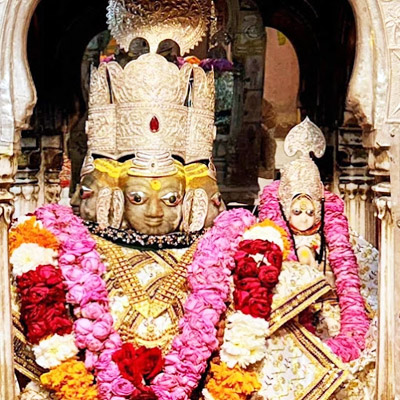
Lord Brahma is worshipped as Jagatpita (Father of the Universe) in Hinduism. Inside the temple, his idol is depicted with four heads, symbolizing his role as the creator of all living beings.
Pushkar is home to more than 500 temples, but only around 80 are historically significant, built between 1658 and 1760. Many of these temples were destroyed by Mughal rulers but were later reconstructed. The Brahma Temple stands out as the most important among them.
The Legend Behind the Temple
 According to Hindu mythology, a demon named Vajranabha was causing destruction on Earth, killing people, and disrupting nature. To end this menace, Lord Brahma threw a lotus flower, which killed the demon. The petals of the lotus fell at three places, forming three sacred lakes:
- Jyeshtha Lake (Elder Lake)
- Madhya Lake (Middle Lake)
- Kanishtha Lake (Younger Lake)
Since the lotus (pushpa) fell from Brahma’s hand (kara), the place came to be known as Pushkar.
Lord Brahma wished to perform a Yajna (holy fire ritual) at Pushkar. To protect the Yajna from demons, he created four hills:
- Ratnagiri (South)
- Nilgiri (North)
- Sanchoora (West)
- Suryagiri (East)
Each hill was assigned a deity to ensure the smooth completion of the Yajna.
The Curse of Goddess Savitri
As per Hindu customs, a wife’s presence is essential for religious rituals. However, when Brahma’s wife, Goddess Savitri, did not arrive on time, he married a Gujjar girl named Gayatri, who was purified by passing through a cow. The Yajna was then completed with Gayatri sitting beside him.
When Savitri arrived and saw Gayatri in her place, she became furious and cursed Brahma, declaring that he would only be worshipped in Pushkar and nowhere else. She also cursed other gods:
- Indra: To be easily defeated in battles.
- Vishnu: To suffer separation from his consort.
- Agni (Fire God): To become all-devouring.
- Priests: To remain poor.
This legend explains why Brahma temples are extremely rare.
History of the Temple
According to the Archaeological Survey of India, the current temple structure dates back to the 14th century, but it is believed that the temple is over 2000 years old. It is said to have been originally built by Lord Vishwakarma, the divine architect.
The temple underwent renovations by Adi Shankaracharya in the 8th century, and later by Maharaja Jawat Raj, who preserved its original structure while enhancing its beauty.
Distinct features of the temple include:
- A red spire (shikhar)
- A Hansa (swan) symbol on the top
- A pillared hall leading to the sanctum
- Molten lead used to join stones
Puja and Rituals
Devotees follow a three-step ritual:
- Take a holy dip in Pushkar Lake
- Visit the temple of Mata Gayatri
- Offer prayers at the Brahma Temple
Interestingly, married men are not allowed inside the sanctum as per the temple’s customs. Only Sanyasis (ascetics), belonging to the Parashar gotra (lineage), can serve as priests.
Festivals Celebrated at the Temple
1. Kite Festival (Makar Sankranti)
Held on January 14th, this festival marks the transition of the sun into Capricorn. People fly colorful kites, take a holy dip in Pushkar Lake, and donate food and money to the needy. Traditional sweets like Gulgula and Malpua are commonly prepared.
2. Pushkar Fair (International Fair)
One of the most famous events in India, the Pushkar Fair takes place from Kartik Ekadashi to Kartik Purnima (October–November). Highlights of the fair include:
- Religious rites and prayers
- Camel and cattle trading
- Cultural performances
- Handicraft exhibitions
- Folk dances and music
The fair concludes on the full moon night, which is considered the most auspicious time to bathe in Pushkar Lake.
3. Krishna Janmashtami
This festival celebrates the birth of Lord Krishna. Devotees gather at the Rangnath Temple, which remains open all night. The festival features:
- Handi Phod (breaking of the curd pot) competition
- Midnight prayers and bhajans
- Nandotsava (Prasad distribution and celebrations)
The Brahma Temple in Pushkar is not just a place of worship but a site deeply rooted in Hindu mythology and history. Its unique religious significance, along with the sacred Pushkar Lake, makes it one of the most important pilgrimage destinations in India. Whether you seek spiritual enlightenment, historical exploration, or cultural festivities, Pushkar offers a divine experience unlike any other.
Have you ever visited the Brahma Temple in Pushkar? Share your experience in the comments below!