
Shree Salasar Balaji Temple, located in the town of Salasar in Churu district, Rajasthan, holds immense religious significance as a sacred site dedicated to Lord Hanuman. Known for its distinctive idol and spiritual atmosphere, the temple attracts devotees from across the country who come to seek blessings and fulfill their desires. The temple’s historical and spiritual aura makes it a revered Shaktiasthal (place of power) and Siddhpeeth (spiritually proven site).
Unique Features of the Idol
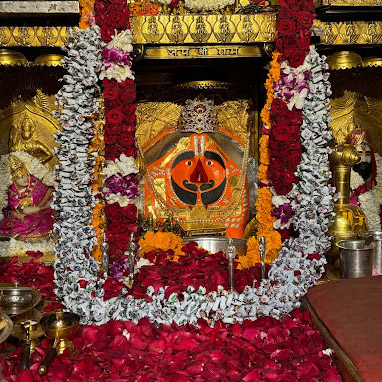
The idol of Lord Hanuman at Salasar Balaji is distinct from other depictions of the deity across India. The face of the idol is round and adorned with a mustache, an uncommon representation of Lord Hanuman. This unique appearance, coupled with the belief that the idol is self-created (swayambhu), draws countless devotees who bow in reverence upon their first glance (Darshan) at the deity.
Bhog, Puja, and Rituals
 Devotees prepare and offer special prasad, including pera, laddu, and churma, as part of their worship. Shops around the temple specialize in these items, ensuring devotees can easily procure them for offerings. A unique tradition at Salasar Balaji is the Savamani Bhog, where devotees who have their wishes fulfilled offer 1.25 mounds (approximately 50 kilograms) of prasad, which may include laddu, pera, or churma. This prasad is then distributed among family members, relatives, and other devotees within the temple premises.
The preparation of the Savamani Bhog can be arranged either in the temple’s kitchen or outsourced, based on the devotee’s preference. This act of devotion showcases the immense faith devotees place in Lord Hanuman’s blessings.
Another common ritual is the tying of coconuts with mouli (red sacred thread) within the temple premises. This act symbolizes the devotee’s wishes and prayers, which they believe will be fulfilled by Lord Hanuman.
Fairs and Festivals
Salasar Balaji Temple hosts grand fairs during Chaitra Purnima and Ashwin Purnima (the full moon days of the Hindu calendar months of Chaitra and Ashwin). These fairs witness a massive gathering of devotees who come together to celebrate with joy and fervor.
Another major celebration is Hanuman Jayanti, observed on Chaitra Shukla Chaturdashi (the fourteenth day of the waxing moon in Chaitra). The temple comes alive with vibrant decorations, rituals, and festivities, attracting pilgrims from far and wide.
The Legend Behind the Temple
The origin of Salasar Balaji Temple is steeped in divine legends. One story narrates that a Jat farmer from Ambota village discovered the idol of Lord Hanuman while plowing his field. He handed it over to the Thakur of Asota, who later gave it to Mohan Das, a Brahmin priest in Salasar. Lord Hanuman is said to have appeared in Mohan Das’s dream, instructing him to construct a temple. Inspired by this divine command, Mohan Das built the temple using mudstone in Samwat 1811 (1754 AD).
An alternate legend recounts that Lord Hanuman appeared in the Thakur of Asota’s dream, instructing him to place the idol on a bullock cart and let the bulls move freely. The temple was to be constructed where the bulls stopped. The bulls halted at Salasar, where the temple was eventually established, giving the town its name. These stories, though lacking historical citations, continue to inspire faith among devotees.
Temple Architecture and Renovation
Over the years, the Salasar Balaji Temple has undergone extensive renovations, transforming it into a magnificent structure entirely crafted from white marble. The prayer hall and parikrama (circumambulatory path) are also constructed with marble, adding to the temple’s grandeur.
The Garbhagriha (sanctum sanctorum), where the idol resides, is adorned with intricate gold and silver artwork. Even the utensils used for puja, rituals, bhog prasad, and arti are made of gold or silver, reflecting the temple’s opulence and the devotion of its followers.
Administration and Facilities
The temple is managed by Hanuman Seva Samiti, a trust responsible for maintaining public amenities and facilitating devotees. The trust oversees the following facilities:
- Accommodation: Numerous dharamshalas are available near the temple, offering comfortable stays at moderate rates. Some prominent options include Ramswaroop Seva Sadan, Bombay Wala Dharamshala, and Kejariwal Dharamshala.
- Dining: Several restaurants around the temple serve food, while sweet shops provide prasad, photographs of Balaji, and religious books.
- Hygiene: Clean toilets and bathrooms are available for devotees.
- Healthcare: Free medical assistance and charitable hospitals are run by the temple committee.
- Drinking Water: Safe drinking water facilities are provided within the temple complex.
Nearby Attractions
Pilgrims visiting Salasar Balaji Temple often explore other nearby religious sites:
-
Anjani Mata Mandir
Dedicated to Mata Anjani, Lord Hanuman’s mother, this temple is located just 1 km from Salasar.
-
Khatu Shyam Baba Temple
Situated 80 km away, this temple is a major attraction for devotees.
-
Ranisati Dadi Temple
Located in Jhunjhunu, this temple is a popular pilgrimage site.
-
Laadlu Jain Temple
A renowned Jain temple, located 40 km from Salasar.
Travel Information
By Road
Regular bus services connect Salasar with Delhi, Jaipur, and other major cities in Rajasthan. State transport buses from Haryana, Rajasthan, and Delhi ply on the Delhi–Jaipur–Sikar–Salasar route. The temple is approximately 160 km from Jaipur.
By Rail
The nearest railway stations are in Sikar and Jaipur. Travelers can take a train to Jaipur or Sikar and then proceed to Salasar by road.
By Air
The closest airport is in Jaipur, located about 170 km away. Jaipur is well-connected to major cities across India by air, with daily flights available.
Temple Timings
The temple opens daily at 4:00 AM and closes at 10:00 PM. During special occasions and festivals like Hanuman Jayanti, the temple remains open 24 hours to accommodate the influx of devotees. The temple committee adjusts the timings based on the gathering.
Salasar Balaji Temple stands as a beacon of faith and devotion, offering solace and spiritual fulfillment to millions. Its unique traditions, vibrant festivals, and serene ambiance make it a must-visit destination for devotees and spiritual seekers alike.